2026 SCC Vol. 8 Part 2:8 Supreme Court rulings on arrest, cheque bounce, contempt and more
Eight rulings in SCC Vol. 8 Part 2 cover grounds of arrest, deficiency in bank service, contempt and cheque bounce.

Bringing you the Best Analytical Legal News


Eight rulings in SCC Vol. 8 Part 2 cover grounds of arrest, deficiency in bank service, contempt and cheque bounce.
Eight Supreme Court rulings on prisons, environmental clearance, operational creditors, police custody, POCSO, POSH and more. This volume of the Supreme Court Cases (SCC), Part 1 of Volume 8, carries key cases decided by the Supreme Court on issues such as constitutional distribution of powers, prior environment clearance, enforcement of claims by operational creditors, grant of police custody, and more.
Key Supreme Court rulings on Article 227, RTE, Teachers Eligibility Test, custody, GST rebate, etc.
Key Supreme Court rulings on Section 36 in Arbitration and Conciliation Act, bail, sale of assets of corporate debtor, suit for injunction, etc.
Key Supreme Court rulings on Article 21, bail, money laundering, arbitral tribunal, etc.
Key Supreme Court rulings on Article 21, government grants, arrest, and preventive detention.
Two Supreme Court rulings on the scope of CCI’s powers and validity of Special Intensive Revision (SIR) of electoral rolls.
5 Supreme Court rulings on when an FIR can be quashed, how S. 436-A bail applies to UAPA-like reverse-burden offences, and what it takes to unwind a confirmed SARFAESI auction sale.
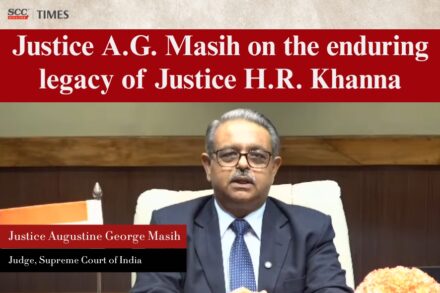
Justice A.G. Masih shares thought-provoking insights on judicial independence, constitutional values, technology, and the evolving justice system at the 5th Justice H.R.
Explore the latest Supreme Court Cases in 2026 SCC Vol. 6 Part 2 on freedom of speech, preventive detention, separate trials, pandemics, and more.
Explore the latest Supreme Court Cases in 2026 SCC Vol. 6 Part 1 on reservations, double taxation, negotiable instruments, and more.
Explore the latest Supreme Court Cases in 2026 SCC Vol. 5 Part 5 on international commercial arbitration, Panchayat elections, corporate debtor, and more.
“…the petitioner, instead of availing the statutory remedy available to him, has chosen to file a petition under Article 227 of the Constitution of India.”
“The case in point is an exemplary instance of misconstruction of intent and a parochially narrow understanding of religious philosophy.”
Explore the latest Supreme Court Cases in 2026 SCC Vol. 4 Part 4 on reference to arbitration, appointment of district judges, electricity distribution, tariff revision, and more.
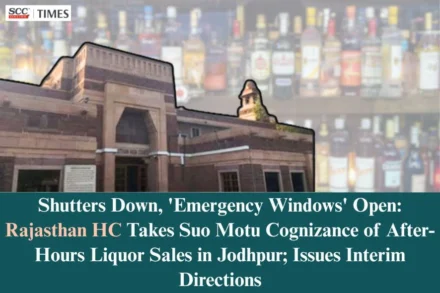
A detailed investigative report published in Rajasthan Patrika titled “शटर डाउन… ‘इमरजेंसी विंडो’ चालू: रात 8 बजें बाद भी धड़ल्ले से बिक रही शराब, supported by photographs, timestamps and field verification, indicated that despite statutory closing hours applicable to liquor vends, liquor sale allegedly continued openly after 8.00 p.m. through concealed openings, restricted access windows and partially shuttered premises at various locations within Jodhpur.
The makers of the Constitution of India advocated for Separation of Power and demarcated the limits, roles and functions of every organ
In Aashirward Films v. Union of India, (2007) 6 SCC 624, Supreme Court laid down that a taxing statute for the reasons of functional expediency and even otherwise, can pick and choose to tax some; so long as the classification is reasonable.
Supreme Court was quick to clarify that if prosecution was unable to prove its case on its own legs, then it won’t be able to derive advantage from the weakness of the defence and the Court would not be able to convict the accused on the strength of the evidence in the form of reply to the suggestions made by the defence counsel to a witness.